
THE REGION. If I’m going to write about my experiences, there’s no better place to start than where I grew up. For those unfamiliar, the Region is the Northwest corner of Indiana, just South of Chicago. It’s a place very well described 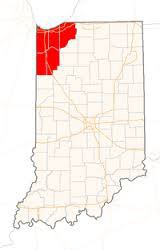 by one word: grit, both literally and figuratively. Literally because it’s a region of the country with a history of significant steel production; figuratively because it’s deeply instilled in the people from there. Because of that, I was very proud when we, in our company, decided to have the term grit included in one of our core values. It’s a value that can take you a long way in life; and something we look for in every person we hire.
Example conversation from the Region link above: Arlington Heights, IL kid to a Region kid (Hammond, IN) at Indiana University
Arlington Heights Kid: Where you from?
Hammond Kid: Chicago
Arlington Heights Kid: Oh yeah me too, where near Chicago?
Hammond Kid: The Region
Arlington Heights Kid: What? Wait, that’s in Indiana, you can’t say you’re from Chicago.
Hammond Kid: Look motherfucker, if the Chicago Tribune says I’m from Chicago, I’m from Chicago!
Mine is a tale of two cities in the Region. I spent the first thirteen years of my life in Hammond, Indiana, an urban suburb of Chicago, where many people I grew up around were tied directly to the mills or the trades associated. Hammond was a microcosm of the country. There were haves and have nots, White, Black, Hispanic, and Asian people, along with every religion imaginable. I loved growing up in Hammond. It was there where my sports obsession began. Being so close to Chicago and growing up during the time of the ’85 Bears, Ditka, and the Jordan era, what sports-infatuated kid wouldn’t have loved it?
When I was midway through my eighth grade school year, my parents decided to move South about 25 miles to Lowell, Indiana. It was still a part of the Region, but couldn’t have been more different than Hammond. Everyone was just like me. There were White, middle class nuclear families in a town where people generally left their doors unlocked. The house we bought was on 10 acres of land. There was a farm across the street and I had to ride a bus to school. Needless to say this was a bit of a shock to a kid that had only ever been on a bus for field trips because I could walk to school my whole life. Interestingly enough, although it couldn’t have been more different, I loved Lowell too. The people there were very welcoming to a kid from Hammond some may not have been too sure about. It certainly didn’t hurt being a decent three-sport athlete in a town that loved to root on their Red Devils. I like to say I was raised in Hammond, grew up in Lowell, but am from the Region.
I’m so fond of where I’m from that when people ask me, I wear it as a badge of honor, “A place called the Region, near Chicago” is where I typically start. By living in both Hammond and Lowell, I was fortunate to learn about different types of people from a variety of social classes and backgrounds. That childhood experience accelerated my ability to adapt in both my collegiate and professional career with a sense of toughness, tolerance and understanding I couldn’t possibly have gotten by only living in only one place or the other. I have to thank my parents for that one. They were unaware at the time, but both places had a significant impact on me.
Enough about me. The point of this post is where you’re from plays an important role in the person you become. Next to your parents, it may be the single largest influence on who you are and what you’re made of. But at some point, you’re on your own and have to produce. Whether the place you’re from is desirable or not is irrelevant. Whether you grew up with people that looked different than you, or the same, doesn’t really matter any longer. That goes for whether you played sports or not, if you went to Harvard or not. Your background matters to an extent and it may help you land an interview for your first job, but in the end your production counts.
My college football coach said something all the time that sticks with me to this day. He said, “No matter where you are, if you do something well enough for long enough, people will find you.” You have to continually produce. How else can we explain someone from West Texas earning a scholarship to Ohio State and never seeing the field; or someone from Nowheresville, Idaho showing up on campus at Oregon as a walk-on and earning a scholarship? People care about production. Of course there may be politics involved at some level and many people love to make excuses and use the phrase, “they play favorites.” One of my coaches had the best reply to that statement. He’d say, “Damn right I play favorites. My favorites are the best players.”
In sports, corporate America and startups, background matters somewhat. But give me someone that’s smart, went to a local State school and is willing to bust their ass, try new things, fail, learn and try again, and I’ll hire them all day over someone who’s entitled from the “right side of the tracks” and not willing to work hard.
My two business partners and I are all from blue collar families from the Midwest and went to State schools (Michigan and Western Michigan). We’ve seen a lot of people come and go in the startup game over the last five years. It’s a tough game and we’re certainly not guaranteed to be “successful” yet, but I sometimes wonder: Would I have seen some of the other startups come and go so quickly if they had more people from the Region, with a little more grit?

 Life After the Lights